

One of the core pieces of advice I give to parents who want stronger community is to make a habit of regularly hosting other families. Having someone inside your home is intimate and vulnerable, and in my experience, one of the fastest ways to build trust. That makes it a precondition to all the other advanced-level community stuff like carpools and sleepovers that make parenting feel easier.
There’s just one problem: the dads aren’t always into it.
Ever since I started writing on Substack about community building for parents, I’ve been getting comments from moms who struggle to apply my advice because, they say, they are married to introverts. I’m all too familiar with this dynamic: I’m a 99th percentile extrovert, and my husband is an introvert. If it was entirely up to me, I’d have friends over for dinner multiple times per week, but that would never fly with him (we’ve compromised at three or four times per month).
I brought up the issue on my mom friends group chat, and many of their marriages fit the same pattern:
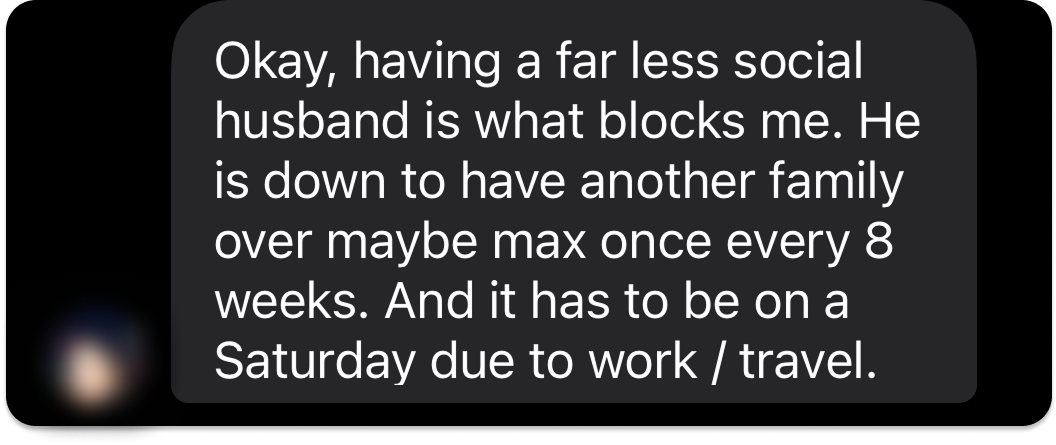
My plan was to write a straightforward post about strategies for hosting when one or both parents are introverts. But I couldn’t help noticing how gendered this topic felt. Women are, on average, slightly more extroverted than men, but the difference is trivial. And the majority of people, whether men or women, land somewhere in the middle of the spectrum. So why does it feel like I’m constantly encountering extroverted women married to introverted men?
Maybe it isn’t so much about introvert vs extrovert as it is about men and women gravitating towards different forms of socializing. Richard Reeves has written that men tend to prefer activities that are “shoulder-to-shoulder”, rather than “face-to-face.” And Darby Saxbe has written about how, on average, dads parent differently than moms, for reasons that are likely both biological and cultural. If men relate to their friends differently, and they relate to their children differently, then it stands to reason that when they’re relating to friends and children at the same time—i.e. engaging in parenting community—they might do this differently, too.
If this is true, then the pattern of dads being less keen on hosting than moms isn’t because the dads are all introverts. It’s because men, on average, have different preferences than women. When moms are the ones doing the social planning, naturally they plan social events that they themselves enjoy: more face-to-face talking, less shoulder-to-shoulder doing. Deep, meaningful conversations about motherhood, friendship, and other relationships nourish my soul like nothing else. But this isn’t the only way to build meaningful connection. A lot of men I know build intimacy by talking about a nerdy shared interest, like video games or bike maintenance. Or through shared experiences, like playing on a team together.
In this post, I’ll share two approaches for bringing dads into parent community:
How to host “shoulder-to-shoulder”
How to make “face-to-face” more dad-friendly
The idea of male vs female ways of socializing is, of course, a broad generalization; I know plenty of dads who love sitting around chit chatting. I’m not solving for them. They should keep doing what they’re doing! But if you are a parent (of any gender!) whose partner never wants to join the social activities you plan, then trying less face-to-face and more shoulder-to-shoulder socializing is at least worth a try.
I was initially resistant to the idea that shoulder-to-shoulder is just as valid as face-to-face. The main way I build trust and connection is by engaging in deep conversation, so I had a hard time imagining it happening any other way. But as Lindsay Meisel, my collaborator on The Family Commons, described it to me,
“I love stereotypically female-coded ways of connecting like long chats, gossiping, and talking on the phone. But I started playing ultimate frisbee a few years ago, and through that experience I developed close relationships with my teammates just by the experience of playing this intense, competitive game together. I rarely talk to the other players about their lives, I don’t know what any of them do for work or even if they are married or have kids. And yet I feel close to them just by virtue of the intimacy and vulnerability of playing together.”
Dads need community just as much as moms
Just because dads on average are less involved in family socializing than moms doesn’t mean that reflects their true nature—or even their best interests. Just look at what happened with dads’ involvement in childcare: In 1965, fathers spent 2.5 hours per week on childcare; today it’s 7.3 hours—a near tripling in two generations. And multiple studies have found that they’re actually enjoying their time with their kids more than mothers do! Rather than assuming that moms are innately wired for caregiving and men are not, we are starting to recognize that both sexes are capable of adapting.
As dads get more involved in parenting, their need for community will increase. It’s lonely to spend long weekends with just your kid and no other adult contact besides your partner. Parenting is easier when you can share the load or simply parent alongside other families. That’s why it’s critical to figure out how to make community building more inviting to dads—so they don’t burn out while still in the process of embracing their caregiving roles, and so they get all the key health and mental wellness benefits too.
Shoulder-to-shoulder hosting
How do you host shoulder-to-shoulder? The two key levers to pull are setting and structure:
Take it outside: even if you don’t have a particular outdoor activity planned, just hanging out outside shifts the whole mood and expectations. It gives everyone a lot more breathing room compared to sitting at a table talking all night. It’s easier to move around the space, shift in and out of conversations, and leave when you want without having to awkwardly signal to people that you want to get them out of your house.
Make it goal oriented: Structuring your time together around some kind of activity or shared goal—like playing a game or working on a project—can make it easier to get to know someone, by removing the pressure to make small talk.
One of my favorite examples of what this can look like in practice is a sideline party. You take a sporting event that part of your family is already planning on attending, like a kid’s soccer game or dad’s pickleball match, and turn the sideline into a social event. This is an easy sell for dads because it’s something they were already doing anyway. But if you’ve ever attended a kids’ sporting event, you know that it’s all too common to spend an hour on the bleachers alongside other parents and not feel like you connected at all. The key is to create a mini-environment that communicates: this is something more!
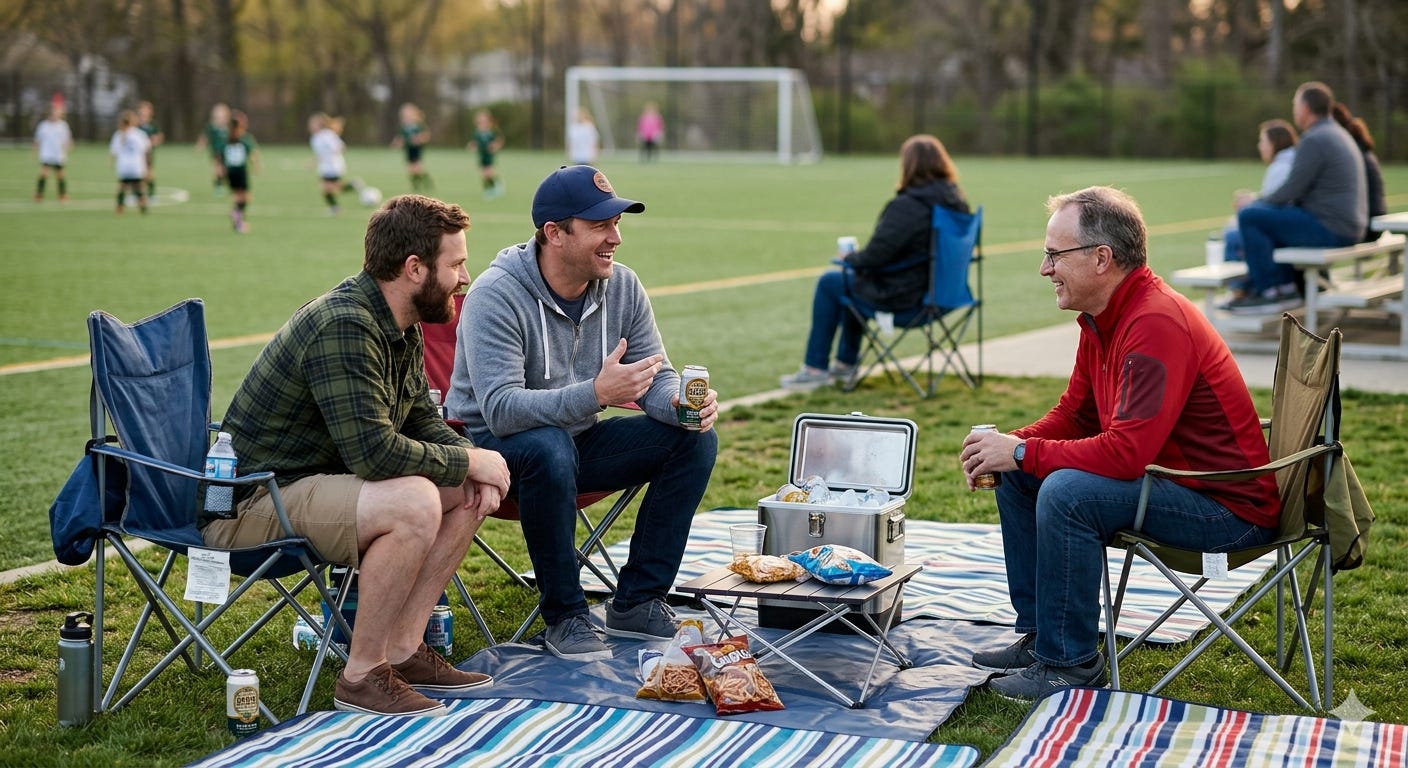
It doesn’t have to be a big lift: coordinate with a couple other parents to bring blankets and chairs, a few snacks, and some beers. This instantly makes it feel more cozy and inviting, and easier to get past small talk into a real conversation. You don’t even have to talk; just sitting on a blanket together, cheering for one another’s kids, helps create the feeling of sharing an experience together.
I once attended a kids’ sports game where someone’s grandmother brought a carafe of homemade iced coffee and fancy cups to serve it in. The parents were just standing on the sidelines of the field, but the coffee made us feel like we were being hosted by that grandmother. Having made this surprising, caring gesture on our behalf, we couldn’t just leave her hanging—we had to talk to her, to each other, to enjoy this space she’d created for us. We shy away from the feeling of indebtedness that these kinds of acts of care create, but it’s one of the things that holds a community together. It’s radically important, if sometimes uncomfortable, that we lean into this feeling of indebtedness. It’s the sign that something important is happening: we are creating emotional ties.
You can follow a similar format for all types of outdoor activities. The key to success is that even though it’s not happening inside your home, you still think of it as a kind of hosting. You’re putting just a bit of effort—as little as a blanket and chairs, or a few beers—to create a container for meaningful connection. A few more ideas:
Beer & balls: In good weather, grab some beers and whatever balls you happen to have in your garage (or even just a stomp rocket) and invite another family to hang out and throw / kick / stomp on things. Just text a few families in the morning and say, “We’re going to throw the frisbee around in the park this afternoon, want to meet us there? We’re bringing a cooler with beers, and juice for the kids!” It’s low pressure, since you’ve framed it as something you were planning on doing anyway. The kids are occupied with whatever activity you brought, so parents who want to talk to each other can do so without getting interrupted. Parents who don’t want to talk can toss a ball around.
Family bike ride or hike: You’re shoulder-to-shoulder and in motion, removing the pressure to make constant, open-ended conversation. I find that conversation actually flows a lot more easily when you’re doing an activity together—maybe something about not being worried about needing to immediately fill awkward pauses. And even if you don’t end up talking much, going through a physical challenge together can bring people closer.
Live music + takeout dinner: Lots of cities have free, outdoor concerts in spring and summer. Look for one that’s not a big, crowded scene, but just a chill place where parents can sit and listen and kids can run around. As with physical activity, listening to music removes the pressure to constantly talk, which can actually make it easier to talk.
How to make face-to-face hosting more dad-friendly
Just to be clear, I’m not saying that you should stop hosting the kinds of events where the main activity is people gathered around the table engaged in open-ended conversation. Hosting dinners is still my family’s primary way of socializing. It’s the perfect container for what I love most: pushing past small talk to get into a deep, animating conversation that is still going strong hours into the evening. And I believe that hosting—having people inside our actual homes—is one of the foundational building blocks for building the trust and intimacy necessary to share care across households. I wouldn’t feel comfortable letting my girls sleep over a friend’s house if I’d never been inside.
But I’ll be honest: I enjoy hosting dinners more than my husband does. (He likes them, and values these relationships, but dinners also drain him and so the calculus is different for him.) So we’ve taken what you might call a “harm reduction” approach to hosting. We still have people over regularly, but with various adjustments to make it work better for him. We feed the kids first and then put a movie on for them. When the adults sit down to eat, it feels way less hectic and overstimulating. And I try to kick people out by 9:30, though admittedly I’m not the best at this and my husband needs to kick my feet under the table to remind me, multiple times. (I posted a note asking for ideas about how to gracefully get people to leave, and there were lots of great ideas.)
You can also try a more structured hosting format—something that makes it feel less like just sitting around a table all night talking:
Give the dads a role: put the dads in charge of a dinner project. The classic one here is a BBQ, where the dads stand around the grill debating their various approaches to brisket. You could also do a pizza-making night where the dads set up stations for rolling out dough and toppings.
Backyard fire pit: Text a few people in the late afternoon, “Want to roast s’mores tonight in the window after dinner and before bedtime?” The kids will run around and play, the parents who want to talk will gather close around the fire, and the parents who don’t will get thoroughly absorbed in maintaining the fire. This is also an easy way to host without having to cook a full meal or have a long, drawn-out evening.
Watching something together: a sporting event, movie night, or awards show offers a focal point that isn’t just open-ended conversation. I also love these for getting to know families in our community where English isn’t their first language.
Game night: Games are not my thing at all (I make an exception for Settlers of Catan). But I’ve definitely seen the way that games—with their built-in structure and competitiveness—can make it easier to get to know someone.
Sometimes, it’s okay to leave dads out
I also think moms need to feel more comfortable doing things on our own, without our partners. In my mom text thread, one of my friend's shared the unspoken social awkwardness of having a husband who doesn't want to show up or host:
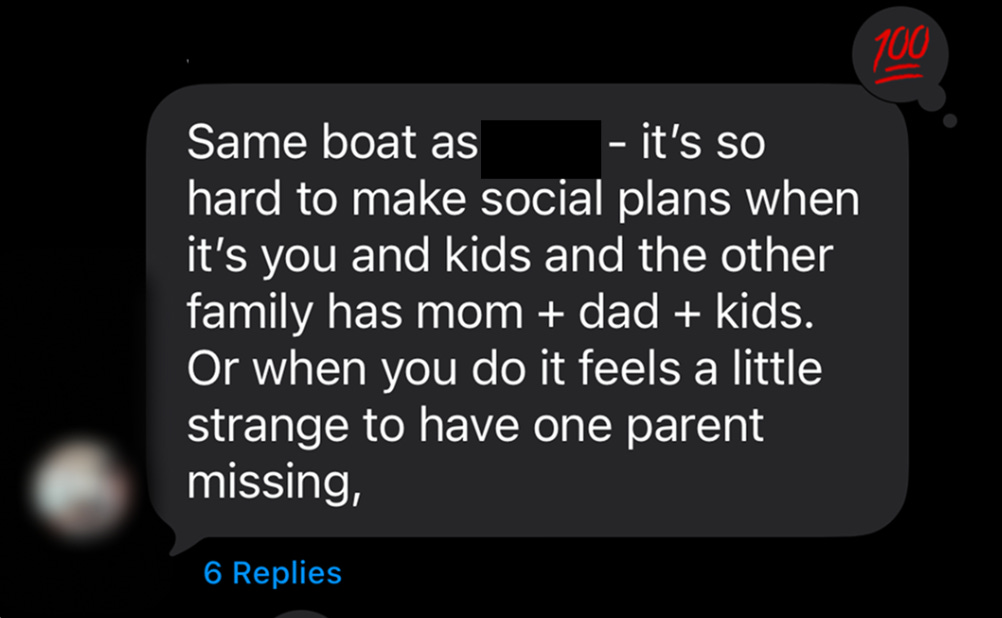
I think it would help if we started normalizing imbalances in who shows up, rather than just canceling if one parent doesn’t want to attend. As an additional benefit, this would be more inclusive for single or separated parents, who are constantly being left out of these dinner flows. Getting rid of the third wheel taboo opens up a lot more opportunity for all parents.
When you’re inviting another family over, make it clear that the invite still stands even if both parents don’t join. If we embraced this new norm, we could ease our discomfort with imbalance, and open up a lot more opportunities to gather and host:
“We’d love to have your whole family, but please still come even if only one parent can make it!”
And if someone invited you but your partner can’t (or doesn’t want) to attend, you can say something like:
“Is it all right if it’s just me and the kids? Alex has been craving a night of staying in and doing nothing, but I’d still love to come!”
Everything I’ve said in this post is about not blaming dads, but rather giving them the benefit of the doubt and making a good faith effort to accommodate them. But I don’t think moms should be endlessly accommodating. One area where I believe moms should not be accommodating is around whether dads should participate in community at all. Dads might want to hang out differently than moms, but that doesn’t mean they can just opt out. Think about the boomer dads who never changed a diaper. That was normal behavior back then, but now would be looked down upon in most circles. We should be firm in expecting dads to participate, but flexible in how that participation happens.