

In the last few months, both the WSJ and the NYT ran features about “lazy parents” who cap their kids’ extracurriculars to one at a time, let them roam the neighborhood without location tracking, and decline to pair their socks. My first reaction was: it’s about freaking time! We’ve been waiting SO long for a movement that pushes back against intensive parenting. Maybe lazy parenting is the concept that makes this finally go mainstream.
But the more I sat with it, the more I felt that as a rallying cry for a new movement, lazy parenting falls short in a really important way: it focuses entirely on what parents should stop doing. Which, don’t get me wrong, is a great start. I relish hearing the ways parents are rebelling against the fear-driven, over-the-top demands of intensive parenting. But to really bring about a cultural shift, we can’t just oppose intensive parenting and all the theater that goes along with it. We have to articulate a positive vision for what should replace it.
Lazy parenting doesn’t do that. While intensive parenting asks us to endlessly optimize our children’s development, lazy parenting asks parents to simply resist that drive. They’re two sides of the same coin, both focused on individual experience and skipping one of the biggest missing pieces of modern parenting: community.
What if, instead of countering intensive parenting with lazy parenting, we countered it with “potluck parenting”? When you go to a potluck, you put effort into preparing a single dish. But because you’re pooling resources with your community, you get a full meal in return. Potluck parenting means putting effort into the parenting practices that create shared value, rather than putting all of your effort into optimizing your own child. It’s embedding your family in a web of care, surrounding yourself with people who support you and whom you support. The parenting behaviors it promotes include hosting regularly, caring for other people’s kids, and advocating for schools to provide parent directories.
If doing all this stuff doesn’t sound very lazy to you, well … you’re right! There’s no denying the fact that potluck parenting takes effort. Some folks can’t fathom prioritizing this work (see comments like this on my Substack). But the payoff is worth it in parenting that feels radically easier and more joyful.
Potluck parenting is a better term for what I think the proponents of lazy parenting are really getting at: the idea that parents should refuse to accept a zero sum vision of the world, where families are competing with each other for limited college spots and good starts in life. What a grim vision of parenting!
We’ve all probably fallen into the trap of intensive parenting at some point. Instead of judging each other for it, let’s poke fun at ourselves as a way to disarm it. In that spirit, I want to share a list of some of the most common excesses of intensive parenting—many of which, as you’ll see, I’m guilty of!—and share some ideas for how we might reframe them around the idea of potluck parenting. I’m stumbling my way through this as much as anyone, and I hope you’ll join me. We’re so much better off when we parent as a team!
Birthday parties
Kids’ birthday parties have gotten hilariously out of hand. Some parents are planning out seating charts, live entertainment, and Instagrammable photo ops that seem detached from any cultural relevance or personal meaning.
I get where the pressure to do this comes from. A birthday can feel like the single most tangible example of how much you love your kid, especially when all their friends are throwing elaborate celebrations. And I’m not against big birthday parties per se. I’ve often felt that our society should do more to mark coming of age milestones with meaningful rituals, and I’m jealous of the way some cultures do this, like bar and bat mitzvahs or quinceañeras.
So how do you throw a birthday party that feels less like a performance and more like a chance to strengthen community connection? For one thing, you don’t always have to invite the whole class. Sometimes it’s better to go deeper with a smaller group of people. Yes, schools sometimes have policies about not leaving people out. But these are meant to avoid a situation where you invite like half the kids, meaning that the other half definitely hears about the party and feels left out. There’s nothing wrong with planning an intimate gathering for 3 or 4 of your kid’s closest friends. Having fewer kids can open up the possibility to do cooler activities. Take everyone out to their first sushi dinner. Or bake a cake together, then lay out a fancy tablecloth and eat it in your backyard.
I also love the idea of doing a joint birthday party with another kid. Co-hosting is an opportunity to get to know another family while also lightening both of your loads: a win-win!
Gift overload
When I got my first invite to a kid’s birthday that included a gift registry, I knew that intensive parenting culture had gone way too far. Turning 8 is not the same thing as getting married or having a baby!
I posted a poll about this recently and 80% of respondents said they preferred no-gift birthday parties. And yet, even though most of us don’t seem to like it, it’s still very hard to opt out of gifting culture. Nobody wants their kid to be the only one to show up to a party empty handed (especially when gift opening is an official ritual of the birthday party 😱).
This is a classic collective action problem. So why not employ a collective solution? All it would take is one parent sending a message to the class at the beginning of the school year: “My kid has wayyyy too many toys already. Is anyone interested in trying a norm of no new gifts for birthday parties this year? We could do hand-me-down toys and books or homemade cards instead.”1
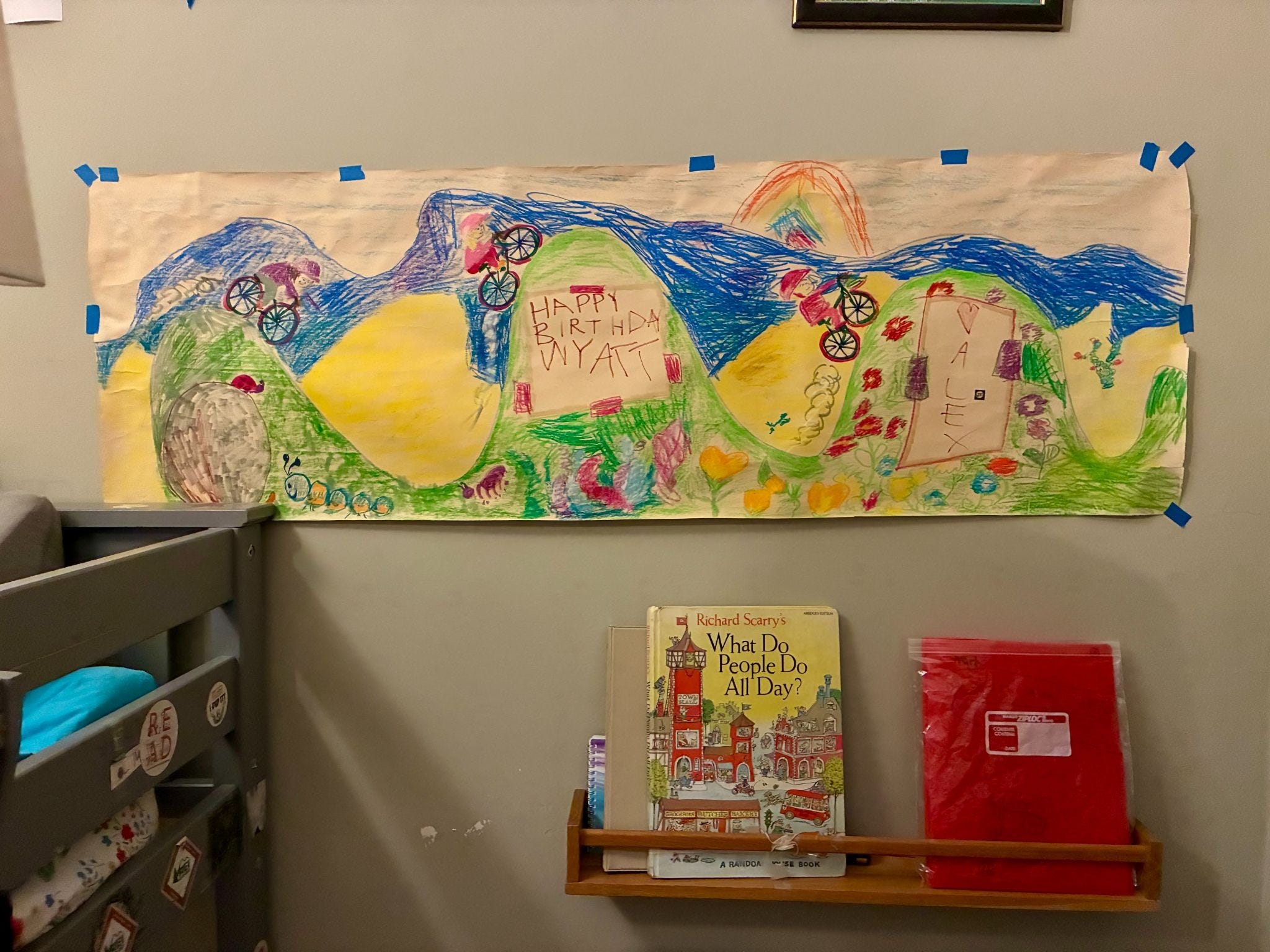
Of course, for this to work, you need a parent directory so you can easily message the whole class, and many schools do not offer one. But even if you can’t convince your whole class to opt out of excessive gifting, you can gift in a way that actually strengthens community ties. The best way to do this is to make birthday gifts fully your kid’s responsibility, so that they are actually involved in an act of care for their friend. Depending on their age, that might mean handing them $20 and letting them figure it out. Or giving a favorite book from your book shelf with an inscription about what this friend means to them (h/t Merida Gorman for this idea!). Or making a really nice card. I once attended a birthday party where one of the kids had made a birthday card on butcher paper. It was a giant mural of friends going on a bike ride. Something the birthday boy could hang on the wall.
Holiday cards
As much as everyone loves making fun of family holiday cards where everyone looks way more happy and put together than you actually are … I have to admit that I do them too! Even though performative holiday cards are a hallmark (no pun intended) of intensive parenting, I just can’t quit them. But I have found ways to make them more focused on connection than performance.
The first two years of being a parent, I hired a photographer to shoot our holiday cards. These days, I use only candids, and hand-write notes for a small subset of recipients I want to especially connect with that year. I also give my kids a stack to send to their friends and teachers to practice handwriting what they love about that person or what they’re grateful for from that year.
So don’t feel like you have to do them at all, but if you’re like me and love them too much to stop (it’s so worth it for the slew of emails and texts I get back every January!), use them as an opportunity to share some vulnerability, whether it’s silly photos, raw reflections, or handwritten thoughts.
School spirit days
When I heard that “Anything but a Backpack Day” is now a common theme for spirit week, I knew we’d lost the plot.
In theory, I should love school spirit days. I’ve argued that schools are our last universal social structure, and we need to do more to make them a hub for local community. The whole point of spirit days is to strengthen the sense of connection and belonging that kids feel to their school. What’s not to love?
The reality for modern families, where both parents are often working, is that they’re just more cognitive load that usually falls on moms. So, what’s the alternative?
If your kid is old enough, make school spirit days their responsibility. The whole point is to build your kid’s connection to the school community, so having to remember and plan an outfit for themselves will better accomplish this goal than you doing it for them. If they forget, and feel bad about being the only kid to show up without crazy hair or whatever, that’s a valuable learning experience.
If your kid is not old enough to manage school spirit day requirements on their own, email school administrators and ask if they’d consider doing something age appropriate that kids can handle themselves. I think 2nd grade is about the earliest we should consider supporting school spirit days if they involve remembering to bring/dress/create something ahead of time. Preschool spirit days should be illegal!
Pinterest-worthy sleepovers
I have a dear friend who bought teepees so she could make her daughters’ sleepover feel extra special. At first, I thought she was being crazy,2 but apparently, there is a whole niche of companies that sell teepees and other sleepover accessories, including decorative pillows, breakfast trays, and accent pieces!
Sleepovers could be a perfect example of potluck parenting. The kids are thrilled, because they get to hang out all night. And the parents are thrilled, because they can take turns getting nights off. Everybody wins. Unless for some reason you choose to make things way harder on yourself!
I do understand where the impulse comes from: you want to make it feel special for your kid, especially if it’s a first sleepover where you want to recognize the milestone. But it’s going to feel special no matter what you do. Kids are happy sharing cereal out of a mixing bowl and sleeping on the floor.
A better place to invest your energy is around connecting with the family of the child who will be sleeping over. Sleepovers create the perfect opportunity to attune your parenting with another family: you have a reason to discuss your preferences around bedtime routines, how their child likes to be soothed, how they handle homesickness and anxiety, their comfort with screens, etc. You can get much closer to other families when the sleepover gives you a reason to have these types of conversations.
Valentine’s Day cards
This is one area where I am 100% successful in pushing back against intensive parenting. I categorically refuse to help my kids with their Valentine’s cards.
I first started my boycott when my girls were in elementary school, when I reminded them about making cards but stopped short at actually doing it for them. Surprise, surprise, they didn’t follow through and ended up being the only ones to show up to school empty handed. That didn’t feel great for them, but they survived to tell the tale. Now, they make their own decision every year about whether they want to participate, fully aware of what it will feel like if they don’t. Some years they choose to, other years they don’t.
This is a great outcome! A Valentine’s gift or card is so much more meaningful if it actually comes from your kid, rather than the parent buying a bunch of disposable stuff from Walgreens. Just like school spirit days, it’s worth it to make Valentine’s fully your child’s responsibility. You can remind them that it’s coming up, and give them suggestions or support depending on their age, but let them take the lead. If they don’t, and they feel disappointed when all the other kids are handing out Valentine’s—that’s okay! It’s actually important for kids to experience the real consequences of their actions.
And if you actually love helping your kid with their Valentine’s, I like this idea from Morgan: she has her preschooler color a bunch of scribbles on a piece of construction paper, then she cuts it into rectangles and writes “Happy Valentine’s Day” on each one. The first time she did this, her son was the only one at school without some kind of store-bought card or goodie bag, and he was so proud of having made something for his classmates himself. What a great way to raise an early community builder!
If any of these intensive parenting traps feels particularly hard to kick, see if you can figure out the source of your attachment. Is it true joy in the process (e.g. you just love baking insanely perfect birthday cakes with fondant recreations of your kid’s favorite movie, you monster)? Or is it perhaps performance or status anxiety, or fear of your kidding being left out? If it’s the last set, try to kick the habit—or even better, transform it into an opportunity to try out potluck parenting.
I’d love to hear from you: what intensive parenting practices do you love to hate? Any that you just can’t quit? Reply to my email, post them in the comments, and maybe we can all brainstorm together about how to turn intensive parenting into potluck parenting.
Some parent communities are probably more open to something like this than others, and I do think parents need to read the room before suggesting something like this so as not to offend people.
To be fair, it was during Covid when kids were losing out on so much and she wanted to make it extra special.
I love the shit out of this post. I identify as a beta mom, not a “lazy parent” because I actually think resistance takes thought and energy. However, I think the ratcheting down of intensive parenting practices is a very important first step because it’s very hard to start to think about how to be a potluck parent if you are overwhelmed with intensive expectations.
The first time I went to a kids’ swim meet I thought “if this much thought, organization and energy went into getting public schools funding and electing Democrats in North Carolina we would live in a completely different world and all of these children would be so much better off.”
I am a firm believer that We have to stop some things before we can start others that build the world we want.
I went to a fancy private school (i.e. my peers were rich and had hired help) and they *still* didn't have kids' parties as extravagant as today's middle class kids' parties (outside of milestones like bar/bat mitzvahs, sweet sixteens, and a handful of other notable exceptions). We did BYO sleeping bag to the sleepover, DIY party favors (or none), and grocery store sheet cake and pizza.
I remember one middle schooler invited 5 of us to her spa-themed party and it was a big deal because she requested bathrobes and my mom had to buy me one because I didn't have one yet. There was no buying of matching robes for us. And guess what: I STILL own that bathrobe today.
Shows how much things have changed in 20ish years